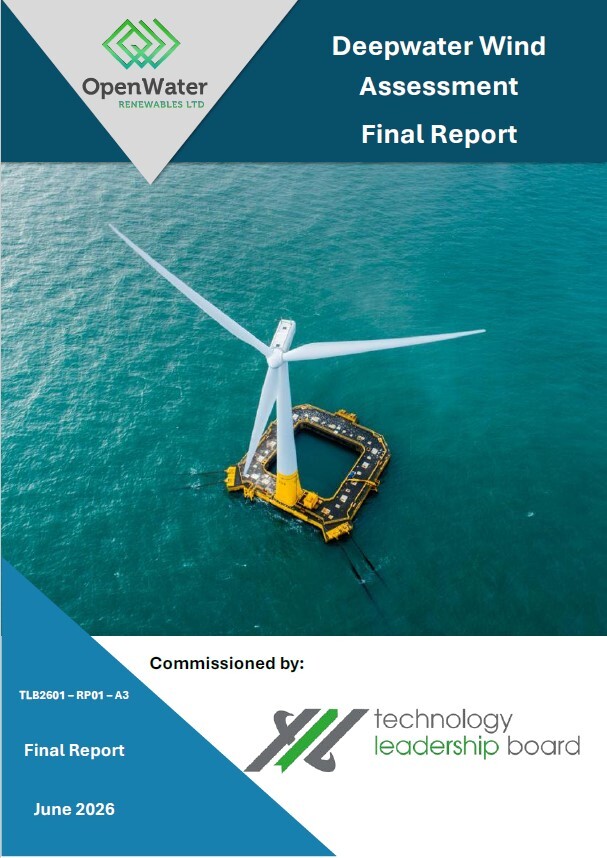
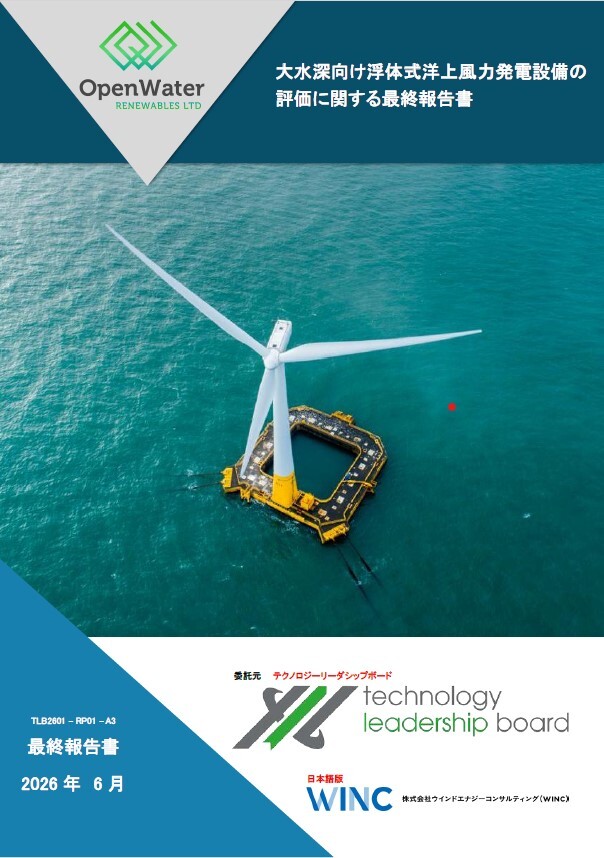
Deepwater Wind Assessment
Report offers blueprint to unleash UK’s deepwater wind potential and boost local content
A successful offshore wind supply chain capable of conquering the deeper waters off the coast of the UK can be put within reach by following the recommendations in a new report Deepwater Wind Assesment.
A competition should be conducted to identify wind turbine foundation designs with the greatest potential for UK content, according to the Deepwater Wind Assessment, written by the OpenWater Renewables consultancy, and commissioned by the Technology Leadership Board (TLB).
The most promising concepts should then be built and trialled – either at dedicated sites, or as a bolt-on to commercial wind farms – to help designers gain the seal of approval for their concepts.
The report also recommends carrying out a study of UK manufacturing capacity, identifying bottlenecks and areas where the development of supply chain skills should be accelerated to boost UK content.
It evaluates the suitability of international and UK designs for North Sea conditions, based on CAPEX, OPEX, installation and repair, performance and risk, helping developers pick the best options from a market saturated with more than 120 designs.
The right designs could help unlock technically challenging deepwater wind projects, including those in the INTOG leasing round, which are aimed at supplying low-carbon power to oil and gas platforms. They could also enable the UK’s supply chain to build capacity ahead of work ramping up on ScotWind developments.
Floating offshore wind is a significant energy transition opportunity for oil and gas industry workers who have transferable skills from managing and delivering complex offshore infrastructure projects.
The final report updates an initial assessment of floating foundation designs, published in June 2025, and includes, for the first time, a review of hybrids, defined as fixed-bottom deepwater wind concepts.
Following the introduction of new concepts to the market since the issue of the 2025 report, six changes were made to the original pool of highest ranked concepts, which is still dominated by semi-submersible and barge platforms that would use concrete or steel, or both.
UK-based companies are actively developing seven concepts, including four hybrids and three floating foundations. Although not among the top-15-ranked concepts, they were praised for incorporating “interesting and innovative features”. Adopting the report’s recommendations could accelerate their development, putting the best concepts among the current frontrunners.
Deepwater hybrid concepts did not feature in the top rankings but may offer potential benefits compared to floating ones. Hybrids would use much less steel than floating alternatives, weighing around half as much as a semi-sub, thereby delivering significant CAPEX savings for the hulls. Hybrids also eliminate the need for wet storage, have a smaller seabed footprint, and can use existing port facilities due to their reduced draft requirements.
The higher costs of installing hybrid concepts and integrating them with turbines, compared with floating ones, partially offsets these savings. In water depths greater than 80m, hybrids would need to be installed by heavy-lift vessels, which at this stage have limited availability and high charter rates, whereas floating concepts can be towed by tugs. However, if hybrids are adopted at scale in optimal water depths, the supply chain may adapt and find ways to reduce these installation costs.
Steve Travers, TLB North Sea Transition Workstream Lead, and Regional Director Subsurface, Baker Hughes, said: “While having a lot of choice is a good thing, having to select from more than 120 concepts is a challenge for developers. Our report helps them narrow the field, make informed selections, and deliver successful deepwater wind projects.”
Mhairi Begg, Senior Technology Adviser of the North Sea Transition Authority, a TLB member organisation, said: “The energy transition, and expansion of the UK’s offshore wind sector into deeper waters, is a massive opportunity for the UK’s supply chain to grow and thrive. This report offers a blueprint to start unleashing this potential and maximise UK content in foundation designs.”
Dr Andrew Newport, report co-author and Technical Director of OpenWater Renewables, added: “There are many innovative floating and hybrid concepts for deep offshore wind which are currently stalled due to lack of funding and sites for demonstrator projects. To unlock this, and allow more of these concepts to be considered for commercial projects, it is critical that we see multi-year offshore demonstration of the high-potential prototypes, at dedicated offshore demonstration sites or within commercial wind farms. A design competition which rewards the winners with such an opportunity would be a great step forward.”
© 2026 Technology Leadership Board™. All Rights Reserved